Anti-Counterfeit Traceability System · 2026 Updated
Anti-Counterfeit Traceability System: One Item One Code, Blockchain Evidence Storage and Supply Chain Tracking Platform Development
Anti-counterfeit traceability systems are evolving from traditional QR code query tools into integrated digital platforms that combine one item one code, blockchain evidence storage, NFC/RFID labels, GS1 digital identity, supply chain data collection, product flow management, digital product passports, and brand risk control backends. For brand owners, manufacturers, distributors, and compliance-focused projects, an anti-counterfeit traceability system is not only used for consumer scan verification. More importantly, it helps enterprises build full-chain data management capabilities from production, quality inspection, warehousing, logistics, distribution, and retail sales to end-user verification.
What Is an Anti-Counterfeit Traceability System?
An anti-counterfeit traceability system is a digital system that uses unique identity codes, label carriers, data collection, scan verification, on-chain evidence storage, flow management, and backend analytics to identify, record, query, and track products throughout their life cycle. It can create a unique identity for every product, package, batch, or logistics unit, and manage production information, quality inspection data, warehouse records, logistics information, distributor data, and end-user query information in a unified platform.
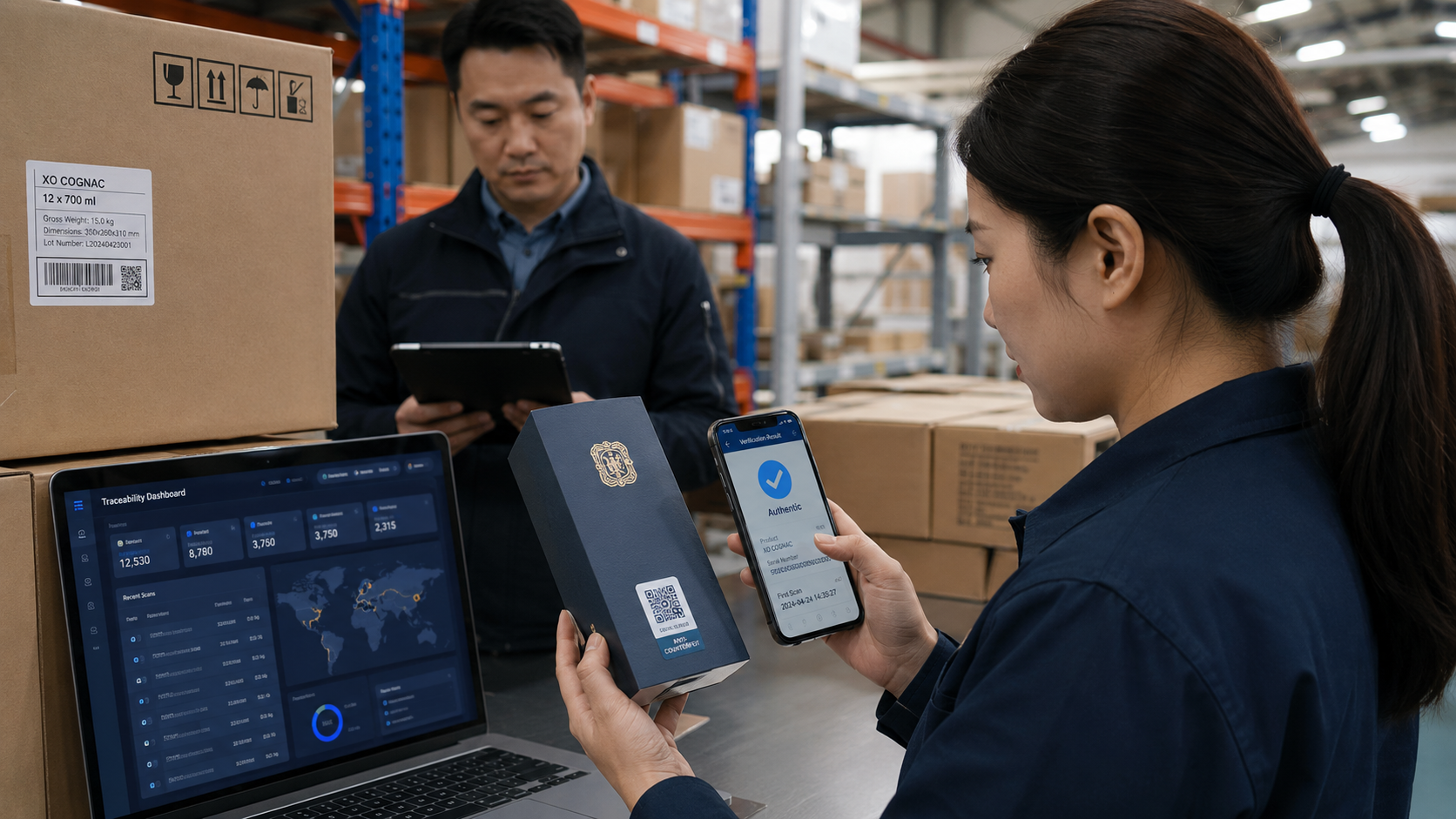
Traditional anti-counterfeit systems often only solve the problem of authenticity verification. A new-generation anti-counterfeit traceability system focuses more on trusted origin, traceable processes, verifiable data, controllable channels, and risk alerts. Enterprises can use the system to view product movement from factory to market. Consumers can scan codes to view product details, batch information, inspection data, authorization records, and anti-counterfeit verification results. Management teams can also identify cross-region sales, repeated scans, abnormal regions, abnormal terminals, and suspicious batches through the backend.
Create a unique digital identity for each item, carton, batch, logistics unit, or certificate to enable refined product-level management.
Generate hashes of key production, inspection, circulation, and verification data and store them on-chain to improve data credibility and auditability.
Cover production, code assignment, inbound storage, outbound delivery, logistics, distribution, retail sales, and consumer scan verification.
New Trends in Anti-Counterfeit Traceability Systems in 2026
In 2026, the development focus of anti-counterfeit traceability systems is changing. Enterprises are no longer satisfied with simple QR code pages. They are paying more attention to data standardization, label security, channel management, cross-border compliance, consumer interaction, and supply chain transparency. Technologies such as GS1 Digital Link, 2D barcodes, NFC smart labels, digital product passports, and blockchain evidence storage are driving anti-counterfeit traceability systems from single-query tools to product digital identity gateways.
| Trend | Development Focus | Enterprise Value |
|---|---|---|
| One Item One Code Upgrade | Support multi-level association of item codes, carton codes, batch codes, logistics codes, store codes, and certificate codes. | Enable product-level tracking, channel flow management, and precise consumer engagement. |
| GS1 and 2D Barcode Applications | Combine GTIN, batch number, serial number, shelf life, production date, and digital links to carry more standardized data. | Improve identification efficiency and data compatibility in retail, warehousing, logistics, and cross-border supply chains. |
| NFC/RFID Smart Anti-Counterfeiting | Use NFC labels, RFID labels, tamper-evident labels, encrypted chips, and multi-verification mechanisms to raise the barrier against counterfeiting. | Suitable for high-value and high-security scenarios such as wine, luxury goods, medical products, beauty products, electronics, and collectibles. |
| Blockchain Trusted Traceability | Store key node data, inspection reports, authorization records, logistics records, and scan verification records as on-chain evidence. | Strengthen tamper resistance and improve trust between brands, distributors, consumers, and regulators. |
| Digital Product Passport | Create searchable, updatable, and traceable digital files for products, covering origin, materials, sustainability, maintenance, and recycling information. | Suitable for exporters, sustainable consumer goods, apparel, electronics, industrial products, and cross-border brand compliance scenarios. |
SZ ChainTech Anti-Counterfeit Traceability System Development Services
SZ ChainTech provides anti-counterfeit traceability system development, one item one code platforms, blockchain traceability platforms, scan verification systems, channel flow management, NFC anti-counterfeiting systems, digital product passports, and brand protection backend customization for brand owners, manufacturers, agricultural enterprises, medical device companies, wine and tea brands, cross-border product companies, and supply chain platforms.
Support generation of item codes, carton codes, batch codes, logistics codes, and certificate codes, with code package management, batch import, code status tracking, and code relationship binding.
After scanning, consumers can view product information, anti-counterfeit results, production batches, inspection reports, authorized channels, traceability paths, and brand information.
Generate on-chain credentials from key business data, supporting hash evidence storage, timestamps, on-chain queries, node records, and trusted audits.
Record product movement from factories, warehouses, agents, distributors, and retail stores, and identify cross-region sales, repeated scans, and abnormal regions.
Support NFC labels, RFID labels, tamper-evident labels, chip verification, anti-copying identification, and repeated scan alerts.
Create digital product files showing origin, materials, craftsmanship, carbon footprint, maintenance records, recycling information, and compliance documents.
Which Industries Are Suitable for Anti-Counterfeit Traceability Systems?
Any industry facing counterfeit risks, channel management pressure, quality traceability requirements, brand protection needs, or cross-border compliance requirements is suitable for an anti-counterfeit traceability system. Different businesses can choose QR codes, NFC, RFID, blockchain evidence storage, or hybrid solutions based on product value, supply chain complexity, and regulatory requirements.
- Food and Beverage: Suitable for production batches, raw material sources, inspection reports, shelf life, warehouse logistics, and recall tracking.
- Wine and Tea: Suitable for single-bottle anti-counterfeiting, gift box tamper protection, channel authorization, scan verification, cross-region sales detection, and membership marketing.
- Beauty and Skincare: Suitable for authenticity queries, batch number verification, ingredient descriptions, authorized stores, import information, and repeat purchase analysis.
- Medical Devices: Suitable for batch traceability, circulation supervision, inbound and outbound records, terminal verification, and abnormal flow alerts.
- Agricultural Products: Suitable for farming records, inspection reports, origin certificates, cold chain logistics, and consumer scan traceability.
- Luxury and High-Value Goods: Suitable for NFC anti-counterfeiting, digital certificates, maintenance records, resale verification, and brand asset protection.
Core Functional Modules of an Anti-Counterfeit Traceability System
A complete anti-counterfeit traceability system usually consists of a code management center, product management, batch management, production collection, warehousing and logistics, channel management, scan query pages, blockchain evidence storage, risk alerts, and data analytics backend. Enterprises can first build basic scan verification functions, then gradually expand to channel flow management, membership marketing, digital product passports, and regulatory reports.
| Module | Main Content | Development Focus |
|---|---|---|
| Code Management Center | Code generation, code import, code binding, code status, code activation, code invalidation, code package export | Support high-concurrency generation, uniqueness verification, duplicate-use prevention, and multi-level package association. |
| Product and Batch Management | Product data, specifications, production batches, inspection reports, production dates, expiration dates | Product data should be structured for reuse in scan pages, backend queries, and regulatory reports. |
| Production and Code Assignment | Production line code assignment, package binding, carton-code association, inbound records, equipment data collection | Can integrate with printers, labeling machines, ERP, MES, WMS, and other systems to improve automation. |
| Warehousing and Logistics Tracking | Inbound, outbound, transfer, shipment, receipt, logistics nodes, regional flows | Associate codes with flow records to form logistics paths from factory to terminal. |
| Scan Verification Page | Authenticity result, scan count, first query time, product details, traceability information, brand reminder | Pages should be mobile-friendly and provide clear prompts to avoid consumer misunderstanding. |
| Risk Alert Backend | Repeated scans, cross-region scans, frequent queries, abnormal stores, suspected cross-region sales, suspected counterfeits | Use rule engines and data models to identify abnormal behavior and help brands respond quickly. |
| Blockchain Evidence Storage Module | Data hashes, timestamps, on-chain credentials, node records, evidence queries, audit logs | Sensitive data should not be stored on-chain in plaintext. Hash evidence storage should be combined with off-chain business data. |
| Data Analytics Dashboard | Scan regions, scan times, channel performance, product popularity, risk trends, user behavior | Help enterprises analyze market flows, channel quality, consumer interests, and brand protection results. |
The Role of Blockchain in Anti-Counterfeit Traceability Systems
Blockchain is not the entire anti-counterfeit traceability system, but it can serve as the trusted data layer. For key data such as production records, inspection reports, authorization certificates, warehouse and logistics nodes, digital certificates, and scan verification records, the system can generate hash summaries from the original data, then write the hash, timestamp, and business identifier on-chain to form a verifiable, traceable, and tamper-resistant evidence chain.
In actual development, anti-counterfeit traceability systems usually adopt an architecture of off-chain business system plus on-chain trusted evidence storage. The off-chain system handles product data, user access, backend management, report analysis, and business workflows, while the on-chain layer handles key node evidence storage and trusted queries. This approach ensures system performance and user experience while improving the credibility of key data.
Anti-Counterfeit Traceability System Development Process
Anti-counterfeit traceability system development should begin by clarifying product types, packaging structures, production processes, channel models, anti-counterfeit strength, and data display scope. Different enterprises have very different needs. Food projects may focus more on batch traceability and recalls, wine projects may focus more on single-bottle anti-counterfeiting and cross-region sales management, and exporters may focus more on product digital identity and compliance document display.
- Requirement Research and Solution Planning: Sort out product types, packaging levels, production processes, channel structures, scan scenarios, anti-counterfeit levels, and backend management needs.
- Code Structure and Label Design: Design item codes, carton codes, batch codes, logistics codes, NFC labels, or RFID labels, and define code rules and binding logic.
- System Prototype and Page Design: Plan scan pages, product files, traceability paths, backend modules, data dashboards, and risk alert pages.
- Backend and API Development: Develop product management, batch management, code management, warehousing logistics, channel flow, scan records, permission management, and data reports.
- Blockchain Evidence Storage Integration: Hash key node data and write it on-chain to generate searchable and verifiable trusted credentials.
- Testing, Launch, and Maintenance: Complete scan testing, stress testing, abnormal scenario testing, equipment integration testing, deployment, and future optimization.
Security Priorities in Anti-Counterfeit Traceability System Development
The security of an anti-counterfeit traceability system is not only about server security. It also includes code security, label security, data security, API security, and backend permission security. If code rules are too simple, they can be copied. If scan pages do not provide abnormal prompts, consumers may not be able to identify risks. If backend permissions are too broad, internal users may also misoperate or modify data incorrectly.
Use highly random code values, encrypted verification, duplicate generation prevention, batch guessing prevention, and anti-brute-force query strategies.
Select ordinary QR codes, tamper-evident labels, NFC chips, RFID labels, or combined anti-counterfeiting solutions based on product value.
Support role permissions, operation logs, approval workflows, IP restrictions, secondary confirmation for sensitive actions, and abnormal alerts.
Why Choose SZ ChainTech for Anti-Counterfeit Traceability System Development?
SZ ChainTech focuses on blockchain application development, enterprise-grade on-chain systems, and digital business platform customization. Based on each brand’s production process, channel structure, and anti-counterfeit requirements, SZ ChainTech can design practical anti-counterfeit traceability systems. We not only focus on scan page display, but also on code structure design, data collection, backend permissions, blockchain evidence storage, channel risk control, and long-term operation analytics.
Design system functions for different scenarios such as food, wine, beauty, agriculture, medical products, luxury goods, and industrial products.
Support on-chain evidence storage, hash verification, timestamp records, digital certificates, and trusted traceability queries.
Plan integrated solutions using QR codes, GS1, NFC, RFID, tamper-evident labels, and digital product passports.
Support cross-region sales detection, repeated scans, abnormal regions, suspicious batches, scan heatmaps, and risk alerts.
Integrate with ERP, MES, WMS, CRM, e-commerce platforms, logistics APIs, production equipment, and third-party data services.
Provide deployment, system optimization, function expansion, data dashboard upgrades, and security hardening services.
What Should Be Prepared Before Developing an Anti-Counterfeit Traceability System?
Before developing an anti-counterfeit traceability system, enterprises can prepare product catalogs, packaging levels, production batch rules, existing label plans, channel structures, warehousing and logistics processes, scan page content, backend role permissions, and whether blockchain evidence storage is required. The clearer the materials are, the more accurate the system planning will be and the more controllable the later implementation cost will become.
| Preparation Material | Description |
|---|---|
| Product and Packaging Information | Include product names, specifications, batches, packaging levels, item code, carton code, and logistics code requirements. |
| Production and Quality Inspection Process | Describe production nodes, quality inspection nodes, inspection reports, production dates, shelf life, and batch management methods. |
| Channel and Warehouse Structure | Describe agents, distributors, stores, warehouses, logistics nodes, and cross-region flow management requirements. |
| Anti-Counterfeit Level Requirements | Clarify whether QR codes, NFC, RFID, tamper-evident labels, encrypted chips, or combined anti-counterfeiting solutions are needed. |
| Scan Page Display Content | Plan the brand introduction, authenticity result, traceability path, reports, and after-sales information consumers need to see after scanning. |
| Backend Management Requirements | Clarify user permissions, operation logs, report statistics, risk alerts, data export, and system integration requirements. |
Frequently Asked Questions About Anti-Counterfeit Traceability Systems
What is the difference between an anti-counterfeit traceability system and ordinary QR code anti-counterfeiting?
Ordinary QR code anti-counterfeiting usually provides only a simple query page. An anti-counterfeit traceability system combines one item one code, batch management, channel flow, scan records, risk alerts, blockchain evidence storage, and backend data analytics, serving consumer verification, enterprise channel management, and brand protection at the same time.
Does an anti-counterfeit traceability system have to use blockchain?
Not necessarily. Basic projects can first use a centralized business system to complete scan verification and flow management. If the enterprise needs stronger data credibility, auditability, or multi-party trust, it can integrate a blockchain evidence storage module and store hashes of key node data on-chain.
Can QR codes be copied? How can anti-counterfeit capability be improved?
Ordinary QR codes may be copied by photography or printing. Therefore, the system should combine highly random code values, first-scan reminders, repeated scan alerts, regional anomaly analysis, tamper-evident labels, NFC chips, or RFID labels to improve anti-counterfeit capability.
Can an anti-counterfeit traceability system identify cross-region sales?
Yes. The system can record product shipment regions, distributors, stores, scan locations, and scan times. When a product is frequently scanned in an unauthorized region or shows abnormal flow patterns, the backend can generate cross-region sales alerts to help enterprises investigate channel issues.
Can SZ ChainTech integrate with existing ERP or warehousing systems?
Yes. The anti-counterfeit traceability system can integrate with ERP, MES, WMS, CRM, e-commerce platforms, logistics APIs, production equipment, and third-party data services according to the enterprise’s existing business process, enabling data synchronization and process linkage.
Get an Anti-Counterfeit Traceability System Development Solution
If you are planning product anti-counterfeiting, one item one code, blockchain traceability, NFC anti-counterfeiting, supply chain traceability, channel flow management, digital product passports, or brand protection systems, you can discuss your specific requirements with SZ ChainTech. SZ ChainTech will provide recommendations on system architecture, functional modules, code structure design, and implementation based on product type, packaging structure, anti-counterfeit level, supply chain process, and launch plan.
ChainUp Blockchain System Development · Professional Consulting & Custom Solutions