Non-Custodial Wallet Development · 2026 Updated
Non-Custodial Wallet Development: Custom Solutions for Self-Custody Assets, DApp Connectivity & Smart Account Wallets
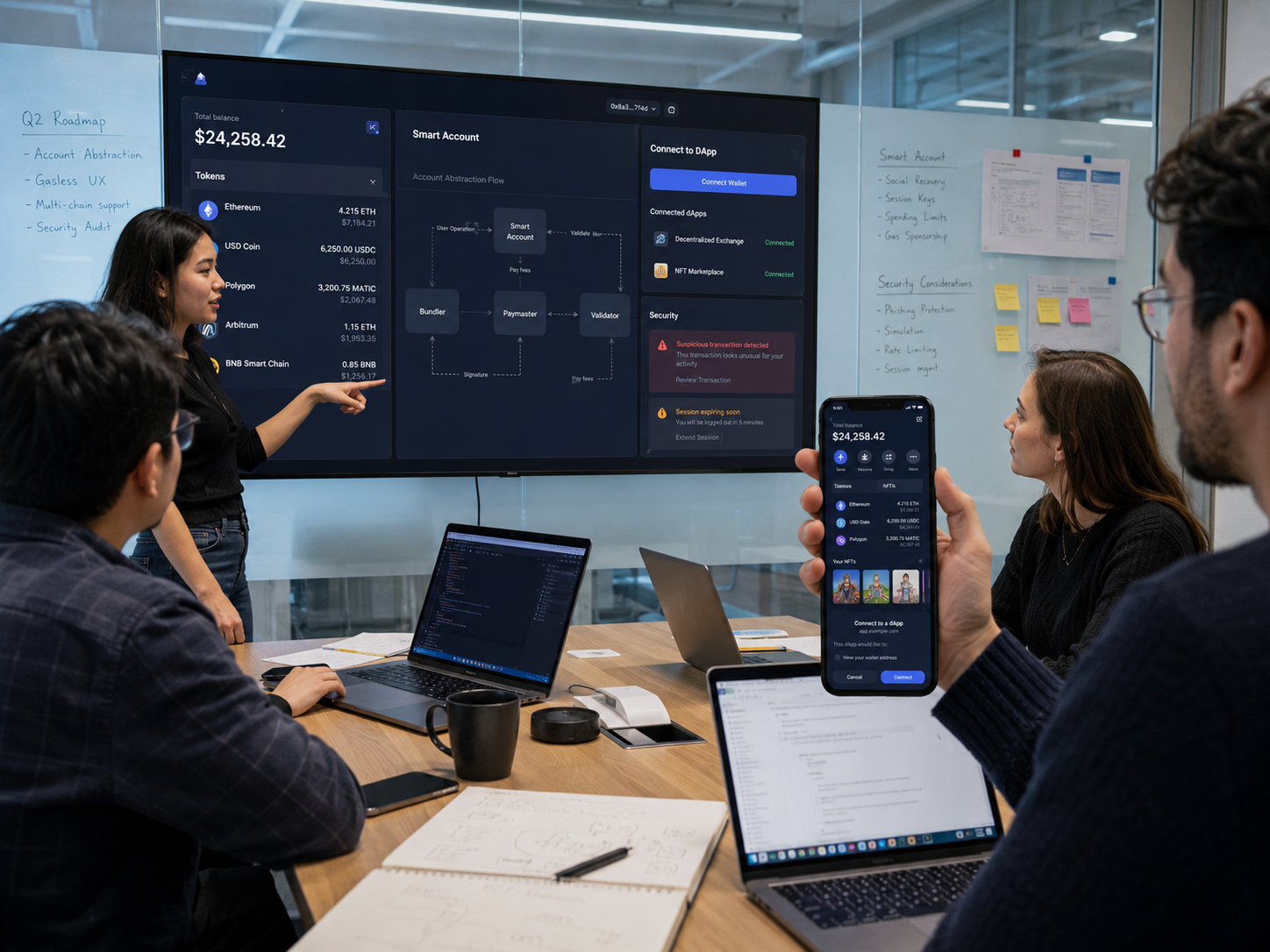
Non-custodial wallet development has evolved from traditional seed phrase, private key, and on-chain transfer tools into an integrated Web3 on-ramp that combines self-custody asset management, multi-chain account support, DApp connectivity, local signing, smart accounts, account abstraction (ERC-4337), Passkey authentication, NFT display, on-chain transaction processing, signature risk warnings, and comprehensive wallet security. For DApp platforms, DeFi protocols, NFT ecosystems, GameFi applications, RWA asset platforms, DAOs, and enterprise Web3 operations, the non-custodial wallet is not merely a tool for storing digital assets—it serves as the critical infrastructure for users to manage on-chain identity, control asset permissions, and access the broader decentralized application ecosystem.
What is Non-Custodial Wallet Development?
Non-custodial wallet development refers to the process of building Web3 wallet systems that enable users to maintain self-custody of private keys, on-chain addresses, digital assets, signature authorizations, and DApp interactions. Unlike custodial wallets, the defining characteristic of non-custodial wallets is that asset control is not centrally held by the platform—users retain sovereignty over their on-chain assets and identities through seed phrases, private keys, local signing, hardware wallets, smart accounts, or other security mechanisms.
A comprehensive non-custodial wallet typically includes wallet creation, wallet import, seed phrase backup, local signing, private key encryption, asset portfolio display, receive/send transfers, NFT management, on-chain transaction history, DApp connectivity, signature approval workflows, revocation of approvals, network switching, gas estimation, risk notifications, and security settings. When developing non-custodial wallets, enterprises must balance user experience with security boundaries—going beyond basic asset lists and transfer screens to address private key protection, signature transparency, malicious DApp risks, contract approval vulnerabilities, and robust user recovery processes.
Wallets do not centrally custody user assets; users control tokens, NFTs, and on-chain entitlements via addresses and signature mechanisms.
Transaction signing occurs client-side; private keys should never be transmitted in plaintext to servers, minimizing centralized breach risks.
Supports WalletConnect, QR code connections, browser extensions, mobile deep linking, and smart contract interaction approvals.
2026 Emerging Trends in Non-Custodial Wallet Development
Entering 2026, the focus of non-custodial wallets has shifted from "users manage their own seed phrases" to "maintain self-custody while dramatically lowering the barrier to entry." Smart accounts, account abstraction (ERC-4337, EIP-7702), Passkey authentication, session keys, gas sponsorship, social recovery, and transaction simulation are fundamentally reshaping wallet product experiences. Users no longer wish to see complex on-chain technical details—they expect wallets to feel as intuitive as traditional web applications while preserving asset control and on-chain transparency.
| Trend Direction | Development Focus | Business Value |
|---|---|---|
| Smart Account Wallets | Support for batched transactions, permission controls, gas sponsorship, session keys, social recovery, and customizable security policies. | Lowers user friction and makes DApp interactions feel comparable to mainstream mobile app experiences. |
| Account Abstraction (AA) | Integration with ERC-4337, EIP-7702, Paymaster, Bundler, and smart contract account optimization. | Enables more flexible signing, recovery, authorization, and fee payment capabilities within wallets. |
| Passkey & Seedless Experiences | Leveraging device keys, biometrics, Passkey, and secure recovery flows to reduce the burden of direct seed phrase management. | Ideal for GameFi, social applications, consumer-grade DApps, and onboarding new users to Web3. |
| DApp Approval Security | Enhanced contract address display, approval amount transparency, transaction simulation, risk detection, and one-click approval revocation. | Reduces asset losses from malicious contract signatures, unlimited approvals, and phishing DApps. |
| Multi-Chain & Modular Wallets | Support for EVM chains, Layer 2 networks, Bitcoin ecosystem, Solana, TRON, NFTs, RWA credentials, and custom asset extensions. | Expands wallet ecosystem coverage, allowing users to manage multi-chain assets and identity from a single entry point. |
Shenzhen ChainUp Technology Non-Custodial Wallet Development Services
Shenzhen ChainUp Technology provides non-custodial wallet development, self-custody wallet systems, multi-chain Web3 wallets, DApp-connected wallets, smart account wallets, browser extension wallets, mobile wallets, and wallet security & risk management modules for DApp projects, DeFi platforms, NFT ecosystems, GameFi projects, RWA asset platforms, DAOs, Web3 social platforms, and enterprise-grade on-chain applications.
Wallet creation, wallet import, seed phrase backup, local signing, private key encryption, asset portfolio display, and on-chain transactions.
Support for EVM chains, Layer 2 networks, TRON, Solana, Bitcoin ecosystem, token assets, NFT assets, and custom chain extensions.
WalletConnect integration, QR code connections, signature requests, contract calls, network switching, approval confirmations, and error handling.
Account abstraction (ERC-4337), gas sponsorship, batched transactions, session keys, social recovery, and improved transaction UX.
NFT display, on-chain credentials, DAO identity, membership entitlements, RWA credentials, and address labeling management.
Malicious address alerts, approval risk detection, transaction simulation, phishing domain identification, audit logs, and security notifications.
Ideal Use Cases for Non-Custodial Wallets
Non-custodial wallets are suitable for any business that requires users to directly control on-chain assets, on-chain identity, and contract interaction permissions. They can be deployed as standalone wallet products or embedded as native wallet gateways within DApps, NFT platforms, GameFi, DAOs, DeFi protocols, RWA platforms, and Web3 communities.
- DApp Platforms: Wallet connection, message signing, contract calls, network switching, and approval management for users.
- DeFi Applications: Staking, swapping, lending, liquidity provision, yield claiming, and approval revocation.
- NFT & Digital Collectibles: NFT display, minting, purchasing, gifting, collection entitlements, and on-chain credential management.
- GameFi & Social Applications: In-game assets, quest rewards, item transfers, account login, and low-friction on-chain interactions.
- RWA Asset Platforms: User identity verification, asset credentials, yield records, subscription operations, and on-chain proof queries.
- DAOs & Membership Systems: On-chain identity, voting governance, permission verification, membership tiers, and community entitlement management.
Core Functional Modules of Non-Custodial Wallet Development
A mature non-custodial wallet system typically comprises account modules, key management modules, asset modules, chain service modules, transaction modules, DApp connectivity modules, security & risk modules, notification modules, and user settings modules. Depending on the user base and asset scale, projects may choose between standard seed-phrase wallets, smart account wallets, embedded wallets, extension wallets, or mobile wallet architectures.
| Functional Module | Key Components | Development Considerations |
|---|---|---|
| Account Creation Module | Wallet creation, wallet import, address generation, account switching, identity labels, Passkey binding | Balance decentralization principles with UX to prevent user drop-off at the first step. |
| Key Security Module | Seed phrases, private keys, local encryption, secure backup, device verification, hardware wallets, recovery flows | Private keys must never be stored in plaintext or transmitted to servers; backup and recovery flows must be clear and verifiable. |
| Multi-Chain Asset Module | Token balances, NFT assets, RWA credentials, asset valuation, transaction history, network switching | Requires integration with node services, indexers, price oracles, and on-chain event listeners for data accuracy. |
| Transaction & Signing Module | Receive, send, transaction broadcasting, gas estimation, signature confirmation, error handling, transaction details | Should clearly display assets, amounts, network, addresses, gas fees, and contract call data to minimize user errors. |
| DApp Connectivity Module | WalletConnect, QR scanning, signature requests, contract calls, network switching, approval revocation | Must clearly display DApp origin, requested permissions, signature payload, and associated risks. |
| Smart Account Module | Gas sponsorship, batched transactions, session keys, social recovery, permission policies, account abstraction | Enhances UX but requires careful design of contract security, recovery rules, and permission boundaries. |
| Security & Risk Module | Malicious address detection, phishing domain identification, approval risk assessment, transaction simulation, blocklists, anomaly alerts | Non-custodial wallets should provide robust risk warnings before signature confirmation, not after. |
| Settings & Notifications Module | Network management, asset management, language preferences, transaction alerts, security reminders, backup prompts | Helps users maintain wallet security over time and improves long-term engagement. |
Technical Architecture of Non-Custodial Wallets
Non-custodial wallets typically follow an architecture of "client-side signing + chain services + asset indexing + DApp connectivity + security & risk management." The client layer handles private key encryption, transaction signing, and account control. Chain services provide node RPC, transaction broadcasting, gas estimation, and on-chain queries. The asset indexing layer manages token balances, NFTs, transaction history, and valuation. The DApp connectivity layer processes signature requests and contract calls. The security & risk layer identifies high-risk approvals, malicious addresses, and phishing domains.
For mobile wallets, special attention must be given to secure storage, device binding, OS permissions, deep linking, QR scanning, and push notification mechanisms. For browser extension wallets, focus areas include injection script security, inter-extension messaging, DApp domain identification, and signature pop-up UX. For embedded wallets, the balance between user experience and non-custodial properties must be carefully managed to avoid sacrificing user asset control in the name of simplification.
Non-Custodial Wallet Development Process
Non-custodial wallet development should begin by defining the wallet form factor—mobile wallet, browser extension wallet, embedded DApp wallet, smart account wallet, or a lightweight wallet tailored to specific business scenarios. The chosen form factor influences account architecture, signing methods, chain service architecture, DApp connectivity approach, security notifications, and ongoing operational costs.
- Requirements Discovery & Wallet Positioning: Define target users, supported chains, asset types, DApp scenarios, smart account requirements, and Passkey support.
- Product Prototyping & Interaction Design: Design wallet creation, wallet import, asset dashboard, transaction signing, DApp connectivity, NFT display, and security center screens.
- Key & Account Scheme Design: Plan seed phrase, local signing, hardware wallet, smart account, social recovery, or embedded wallet approach.
- Multi-Chain & DApp Connectivity Development: Integrate node services, indexers, WalletConnect, network switching, contract calls, approval revocation, and transaction broadcasting.
- Security & Risk Management + QA: Implement phishing domain detection, approval risk alerts, transaction simulation, signature payload parsing, and edge-case testing.
- Deployment & Continuous Iteration: Complete mobile or extension release, node monitoring, security patches, feature enhancements, and multi-chain expansion.
Security Priorities in Non-Custodial Wallet Development
The security core of non-custodial wallets lies in user asset control and signature permissions. Many risks originate not from the wallet interface itself, but from seed phrase leaks, phishing sites inducing malicious signatures, unlimited contract approvals, incorrect network transfers, token spoofing, improper private key backups, and users' inability to understand signature payloads.
Private keys should never be stored in plaintext. Seed phrase backup flows must include strong warnings against screenshots, clipboard copying, or cloud uploads.
Before signing, wallets should display approval asset type, amount, contract address, DApp domain, network name, and risk warnings, with easy access to approval revocation.
Flag suspicious amounts, blacklisted addresses, questionable contracts, phishing domains, cross-chain errors, and abnormally high gas fees.
Why Choose Shenzhen ChainUp Technology for Non-Custodial Wallet Development?
Shenzhen ChainUp Technology specializes in blockchain application development, Web3 wallets, non-custodial wallets, multi-chain asset systems, DApp connectivity components, and enterprise on-chain platform development. We tailor secure, user-friendly, and extensible non-custodial wallet systems to your specific business scenarios and target audiences. Our expertise goes beyond wallet UI to encompass private key security, signature UX, multi-chain integration, DApp approvals, smart accounts, and ongoing security iteration.
Seed phrase management, local signing, wallet import/export, asset display, on-chain transfers, and NFT management.
EVM chains, Layer 2 networks, TRON, Solana, Bitcoin ecosystem, tokens, NFTs, and custom asset extensions.
WalletConnect, contract calls, signature approvals, network switching, approval revocation, and DApp interaction components.
Account abstraction (ERC-4337), gas sponsorship, batched transactions, social recovery, and Passkey login experiences.
Risk address detection, phishing domain identification, approval auditing, transaction simulation, anomaly alerts, and security center modules.
Deployment support, node optimization, multi-chain expansion, security hardening, feature upgrades, and wallet version maintenance.
What to Prepare Before Developing a Non-Custodial Wallet
Before initiating non-custodial wallet development, enterprises should define the wallet form factor, target users, supported chains, asset types, DApp connectivity needs, NFT support requirements, smart account adoption, Passkey implementation, mobile/extension development, and security/risk module scope. Clearer preparation leads to more predictable wallet architecture, development timelines, and security cost management.
| Preparation Item | Description |
|---|---|
| Wallet Form Factor | Mobile wallet, browser extension wallet, embedded DApp wallet, smart account wallet, or lightweight wallet. |
| Supported Chains & Assets | Public chains, Layer 2 networks, tokens, NFTs, RWA credentials, or custom project assets. |
| Account & Key Scheme | Seed phrase, local private keys, hardware wallet, Passkey, smart account, or social recovery approach. |
| DApp Connectivity Requirements | WalletConnect, QR scanning, contract calls, signature approvals, and approval revocation capabilities. |
| Security & Risk Requirements | Phishing detection, malicious address screening, transaction simulation, approval risk alerts, and blocklist rules. |
| System Integration Needs | Integration with DApp platforms, NFT systems, GameFi projects, RWA platforms, price oracles, or node services. |
Non-Custodial Wallet Development FAQs
What is the difference between a non-custodial wallet and a custodial wallet?
In a non-custodial wallet, users control their private keys and on-chain assets independently—the platform does not centrally custody user funds. Custodial wallets have the platform manage accounts and asset deposits/withdrawals. Non-custodial wallets emphasize user sovereignty but require better backup, recovery, and risk notification design.
Is a seed phrase required for non-custodial wallets?
Not necessarily. Traditional non-custodial wallets use seed phrases, but hardware wallets, smart accounts, Passkey, social recovery, or embedded wallet solutions can reduce the burden of direct seed phrase management for end users.
Can non-custodial wallets connect to DApps?
Yes. Non-custodial wallets can connect to DApps via WalletConnect, browser extensions, QR scanning, mobile deep linking, and support signature approvals, contract calls, network switching, and approval revocation.
Does a smart account compromise the non-custodial nature of a wallet?
Not necessarily. Smart accounts can enhance permission controls, recovery mechanisms, and transaction UX. The key factor is how account control, signature authority, and recovery rules are designed. If users retain core control, smart accounts serve as a UX upgrade for non-custodial wallets.
Can Shenzhen ChainUp Technology develop both mobile and browser extension non-custodial wallets?
Yes. Non-custodial wallets can be developed as mobile apps, browser extensions, embedded DApp wallets, or multi-platform combinations based on business requirements, with support for multi-chain assets, DApp connectivity, NFT display, smart accounts, and security/risk modules.
Get Your Non-Custodial Wallet Development Proposal
If you are planning a non-custodial wallet, self-custody Web3 wallet, DApp-connected wallet, smart account wallet, NFT wallet, GameFi wallet, or multi-chain asset wallet, reach out to Shenzhen ChainUp Technology to discuss your specific requirements. Based on your wallet form factor, supported chains, asset types, account scheme, security level, and deployment timeline, we will provide architecture recommendations, functional module breakdowns, key management strategies, and implementation roadmaps.
ChainUp Blockchain Development · Professional Consulting & Custom Solutions