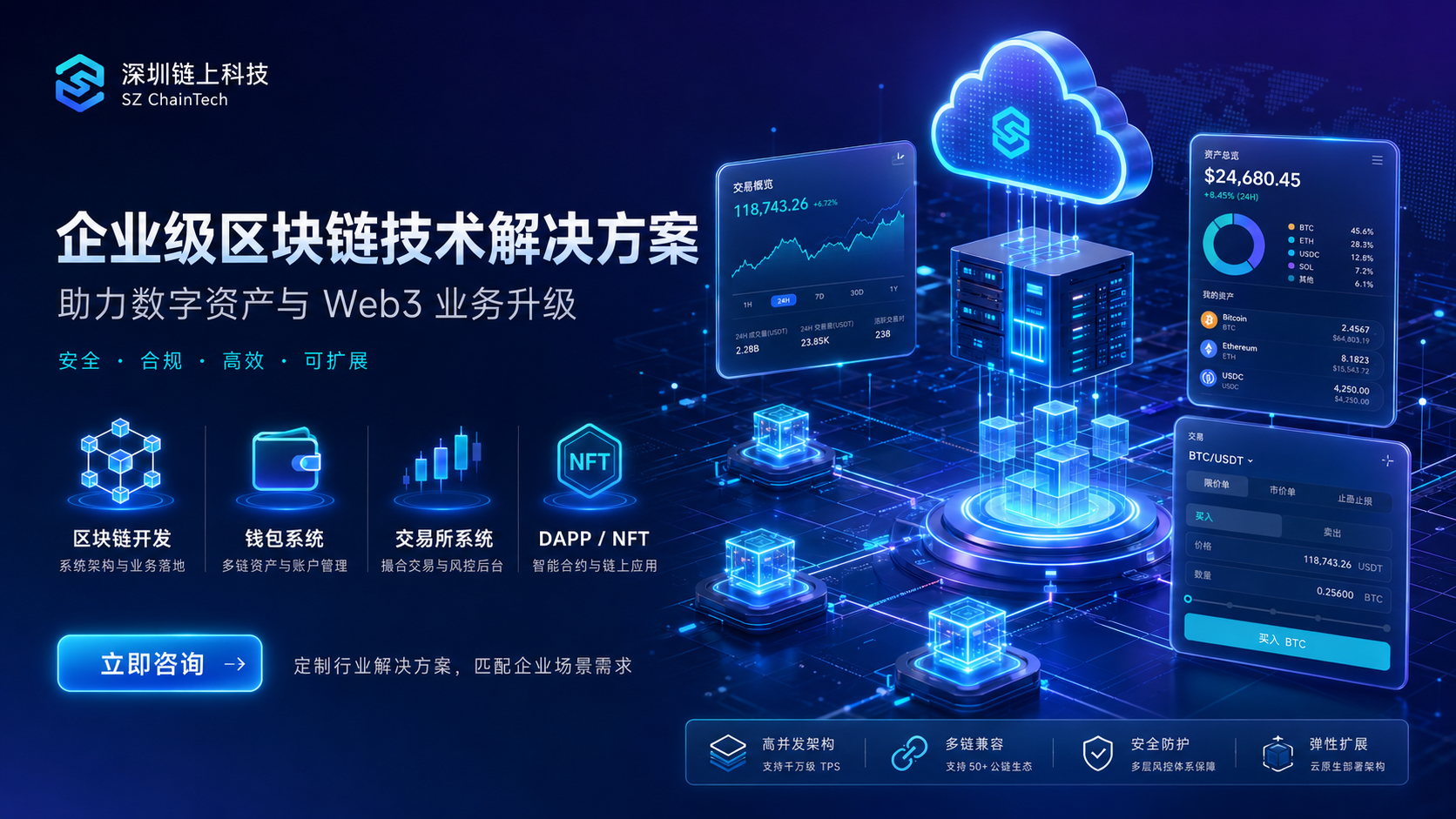
Blockchain System Development · 2026 Updated

Blockchain System Development: Enterprise On-Chain Applications and Digital Asset System Solutions
Blockchain system development has evolved from simple on-chain data storage into a comprehensive engineering field covering digital assets, smart contracts, Web3 wallets, trading engines, RWA assets, supply chain traceability, digital copyright, DAPP/NFT platforms, compliance risk control, and multi-chain data services. For enterprises, a valuable blockchain system is not just about deploying a chain or a contract. It is about integrating business processes, asset circulation, user permissions, trusted data, audit trails, and long-term operations into a secure, stable, and scalable platform.
What Is Blockchain System Development?
Blockchain system development refers to the process of building business systems based on distributed ledgers, cryptography, smart contracts, on-chain data, digital identity, tokenized assets, and decentralized interactions. It includes underlying chains, consortium chains, public chain nodes, contract protocols, and on-chain data interfaces, as well as user-facing applications, admin backends, risk control systems, wallet systems, trading modules, data analytics, and third-party API integrations.
Compared with traditional software development, blockchain systems place greater emphasis on tamper-resistant data, traceable transactions, asset ownership verification, automated process execution, and trusted multi-party collaboration. When enterprises develop blockchain systems, they should not only consider whether data can be put on-chain, but also how on-chain and off-chain data correspond, how keys are managed, how contracts are upgraded, how permissions are layered, how abnormal transactions are identified, how user assets are protected, and whether the system can support audits, scaling, and long-term maintenance after launch.
Business data can be converted into traceable, verifiable, and auditable on-chain credentials through hashes, timestamps, node consensus, and transaction records.
Asset issuance, permission control, settlement rules, revenue sharing, staking redemption, and authorization flows can be written into contracts to improve execution efficiency.
Web platforms, mobile apps, admin dashboards, wallet interfaces, API services, and data panels help transform on-chain capabilities into real business applications.
New Trends in Blockchain System Development in 2026
In 2026, enterprise blockchain projects are placing more emphasis on compliance, assetization, account experience, and system security. Projects based purely on concepts are decreasing, while practical systems are being built around clear business scenarios, including RWA asset mapping, stablecoin payment scenarios, on-chain points, supply chain finance, digital copyright credentials, enterprise wallets, trading engines, on-chain risk control, and auditable data exchange.
| Trend | Development Focus | Enterprise Value |
|---|---|---|
| Compliant Digital Asset Systems | Reserve capabilities for KYC/KYT, AML risk control, risk address identification, audit reports, regulatory interfaces, and permission tracking. | Reduce future adjustment costs while improving platform credibility and long-term operational stability. |
| RWA and Asset Tokenization | Design systems around asset registration, valuation, ownership confirmation, layered management, income records, redemption processes, and on-chain credentials. | Help physical assets, financial assets, rights certificates, and point assets enter a digital circulation system. |
| Smart Accounts and Wallet Experience | Support batch transactions, gas sponsorship, session keys, permission control, social recovery, and multi-signature approval. | Lower the barrier for ordinary users and make Web3 applications closer to traditional internet product experiences. |
| Multi-Chain and Cross-Chain Infrastructure | Integrate EVM chains, Layer2 networks, consortium chains, cross-chain bridges, node services, on-chain data indexing, and unified asset display. | Avoid dependence on a single chain ecosystem and make it easier to expand more assets and business scenarios later. |
| On-Chain Risk Control and Data Analytics | Build abnormal transaction monitoring, address profiling, fund flow tracking, hot and cold wallet alerts, backend audits, and automated warnings. | Improve digital asset security and reduce risks related to asset loss, interface abuse, and operational incidents. |
SZ ChainTech Blockchain System Development Services
SZ ChainTech provides one-stop blockchain system development services for enterprises, project owners, digital asset platforms, traditional industries, FinTech teams, and Web3 startups. The development scope can be flexibly combined according to the project stage. We can build a complete platform from scratch or upgrade an existing system with on-chain capability integration, smart contract transformation, wallet module expansion, or risk control backend enhancement.
Support consortium chains, public chain nodes, EVM-compatible chains, block explorers, on-chain data indexing, RPC services, node monitoring, and multi-chain asset access.
Cover token contracts, NFT contracts, staking contracts, revenue-sharing contracts, governance contracts, permission contracts, airdrop contracts, and business automation contracts.
Support multi-currency and multi-chain assets, deposits and withdrawals, private key management, mnemonic phrases, MPC/multi-signature, address generation, transaction records, and asset reports.
Support spot trading, contract trading, OTC trading, matching engines, market data systems, fund accounts, fee settings, risk control, and operation backends.
Provide DAPP development, NFT platforms, digital collectibles, RWA asset registration, on-chain credentials, asset display, minting, issuance, and secondary circulation modules.
Provide on-chain evidence storage, authorization queries, and trusted traceability solutions for goods, copyrights, certificates, bills, documents, artworks, and supply chain data.
Typical Scenarios for Blockchain System Development
Blockchain technology is not necessary for every business. However, when a project involves multi-party collaboration, asset circulation, trusted data, rights confirmation, transaction settlement, cross-border cooperation, or long-term auditing, a blockchain system can significantly improve platform credibility and automation efficiency.
- Digital Asset Platforms: Used to build wallets, exchanges, asset management, clearing and settlement, K-line market data, risk control backends, and user asset reports.
- RWA Asset Systems: Used for digital management of real estate, bills, debt, carbon assets, computing power, income rights, and membership rights.
- Supply Chain Traceability: Used for product origin, warehousing logistics, inspection reports, distribution paths, anti-counterfeiting verification, and consumer queries.
- Digital Copyright Systems: Used for work registration, copyright confirmation, authorization records, on-chain certificates, NFT credentials, and infringement evidence support.
- Enterprise Points and Membership Rights: Used for points issuance, exchange, write-off, cross-platform circulation, rights layering, and data auditing.
- Web3 Application Platforms: Used for DAPPs, DAO governance, NFT communities, blockchain game assets, task systems, airdrop systems, and on-chain identity.
Core Architecture Design of Blockchain Systems
A mature blockchain system usually consists of a business layer, application layer, contract layer, chain service layer, data layer, security layer, and operations layer. Different projects may choose lightweight or enterprise-grade architectures depending on business complexity, but account, asset, permission, data, and security strategies must always be clear and controllable.
| Architecture Layer | Main Modules | Design Focus |
|---|---|---|
| User Application Layer | Official website, H5, app, mini program, DAPP, admin backend | Focus on smooth interaction, clear information, real-time asset status synchronization, multi-language support, multi-terminal adaptation, and role-based access. |
| Business Service Layer | Account system, order system, asset system, permission system, message system, reporting system | Handles off-chain business logic and ensures transactions, reviews, settlements, notifications, and operations are traceable. |
| Smart Contract Layer | Asset contracts, NFT contracts, staking contracts, revenue-sharing contracts, governance contracts | Contracts require security audits, permission isolation, upgrade plans, event log design, and abnormal rollback strategies. |
| Chain Service Layer | Node services, RPC interfaces, block scanning, transaction broadcasting, on-chain event monitoring | Ensure accurate synchronization of on-chain data and support multi-chain expansion, high node availability, retry mechanisms, and transaction status confirmation. |
| Security Risk Control Layer | Multi-signature, hot and cold wallets, risk control rules, risk address databases, audit logs, alert systems | Build security defenses across assets, accounts, interfaces, contracts, backend operations, and servers. |
| Operations and Monitoring Layer | Log analysis, performance monitoring, disaster recovery, version release, data backup | Ensure stable operation under high concurrency, market volatility, chain congestion, and unexpected incidents. |
Blockchain System Development Process
Before starting blockchain system development, enterprises should first clarify business goals and system boundaries. Only when user roles, asset types, fund flows, data flows, permission models, contract rules, and compliance requirements are clearly defined can unnecessary rework be avoided later.
- Requirement Research and Business Analysis: Clarify project positioning, target users, asset types, on-chain data scope, operation processes, system roles, and future expansion directions.
- Product Prototype and Architecture Planning: Design frontend pages, backend functions, business flows, database structures, contract modules, API documents, and node deployment plans.
- Smart Contract and Backend Development: Complete contract coding, server-side APIs, account asset logic, transaction processing, risk control strategies, data indexing, and backend permission systems.
- Frontend and Multi-End Application Development: Build web platforms, mobile apps, DAPP pages, wallet interactions, asset displays, order records, operation confirmations, and message notifications.
- Testing, Audit, and Security Hardening: Conduct functional testing, stress testing, contract testing, permission testing, API security testing, risk control verification, and abnormal process testing.
- Deployment, Launch, and Iteration: Complete server deployment, node configuration, domain certificates, monitoring alerts, data backups, version releases, and continuous functional iteration.
Security and Compliance Are the Core of Blockchain System Development
Once a blockchain system involves digital assets, user funds, private key signatures, on-chain authorization, or trading engines, its security requirements must be higher than those of ordinary information systems. Enterprises should establish security strategies from the early project stage rather than trying to fix problems after launch.
Select private key custody, multi-signature, MPC, hot and cold separation, approval workflows, and withdrawal limits according to asset scale.
Complete unit testing, simulated attacks, permission verification, reentrancy checks, overflow checks, and third-party audits before launch.
The backend should support role hierarchy, secondary confirmation for sensitive operations, IP whitelisting, operation logs, approval workflows, and abnormal alerts.
Why Choose SZ ChainTech for Blockchain System Development?
SZ ChainTech focuses on enterprise-grade blockchain and digital asset system development. Based on each project’s business model, application scenario, user scale, and security requirements, we provide practical technical solutions. Compared with simply delivering source code, enterprises need systems that can support continuous operation, easy expansion, convenient maintenance, and adaptation to market changes.
Cover blockchain infrastructure, wallets, exchanges, DAPP/NFT platforms, RWA assets, anti-counterfeiting traceability, digital copyright, and backend management systems.
Focus on high concurrency, data consistency, API stability, asset security, disaster recovery, and long-term version iteration.
Reserve identity authentication, on-chain risk control, audit logs, risk address identification, and compliance report capabilities from the development stage.
Integrate mainstream public chains, EVM-compatible chains, consortium chains, Layer2 networks, and third-party Web3 infrastructure according to business needs.
Customize accounts, assets, transactions, revenue sharing, reviews, permissions, data dashboards, and message notifications according to platform operation models.
Provide deployment, monitoring alerts, incident response, functional iteration, security hardening, and long-term technical maintenance services.
What Materials Are Needed Before Blockchain System Development?
To improve communication efficiency, enterprises can prepare a project introduction, target users, core functions, asset types, target chains, budget range, launch schedule, compliance requirements, and reference platforms before consulting a blockchain development team. The clearer the materials are, the easier it is for the development team to evaluate the technical route and implementation cost.
| Material | Description |
|---|---|
| Business Model | Explain whether the project is a wallet, exchange, RWA platform, NFT platform, traceability system, copyright system, points system, DAPP, or comprehensive platform. |
| Function List | List the functions needed for the user side, backend side, asset side, contract side, risk control side, and data side. |
| Chain and Asset Types | Clarify which public chains, tokens, NFTs, points, credentials, or real-world asset mappings are planned for integration. |
| Security Requirements | Specify whether multi-signature, MPC, hot and cold wallets, KYC, KYT, AML, risk control rules, and audit logs are required. |
| Launch Plan | Include the expected launch time, target market, operation team, future expansion direction, and maintenance requirements. |
Frequently Asked Questions About Blockchain System Development
How long does blockchain system development usually take?
The development cycle depends on system complexity. Simple on-chain evidence storage, NFT minting, or a single DAPP usually takes less time. If the project involves wallets, trading engines, risk control backends, multi-chain assets, KYC/KYT, contract audits, and multi-end applications, the cycle will be longer. It is recommended to complete requirement evaluation and prototype planning before confirming an accurate development timeline.
Does an enterprise have to develop its own public chain or consortium chain?
Not necessarily. Many enterprise-grade applications can be developed based on mature public chains, EVM-compatible chains, Layer2 networks, or consortium chains. Whether to build a dedicated chain should be evaluated based on data privacy, node governance, transaction cost, performance requirements, ecosystem compatibility, and long-term maintenance capability.
Must blockchain system development include smart contracts?
If the system involves asset issuance, rights circulation, automatic settlement, NFT minting, staking rewards, or on-chain governance, smart contracts are usually required. If the system only needs data evidence storage, query verification, or internal auditing, a lighter on-chain hash storage approach may also be used.
What is most important when developing a digital asset system?
Asset security, permission control, contract security, risk control strategies, and audit trails are the most important factors. A digital asset system must carefully design deposit and withdrawal processes, private key management, backend approvals, risk address identification, abnormal transaction alerts, and disaster recovery mechanisms.
Can SZ ChainTech perform secondary development based on an existing business system?
Yes. For existing user systems, e-commerce systems, points systems, supply chain systems, or FinTech platforms, blockchain capabilities can be integrated through APIs, wallet interfaces, smart contracts, on-chain evidence storage, and data synchronization modules. A complete rebuild is not always necessary.
Get a Blockchain System Development Solution
If you are planning a blockchain system, Web3 wallet, digital asset platform, exchange system, DAPP/NFT platform, RWA asset system, anti-counterfeiting traceability system, or digital copyright platform, you can discuss your project requirements with SZ ChainTech. We will provide recommendations on system architecture, functional modules, development timeline, and implementation path based on your business scenario, technical difficulty, security requirements, and launch plan.
ChainUp Blockchain System Development · Professional Consulting & Custom Solutions